Class 12 Mathematics Chapter 5 – Kinematics of Motion in a Straight Line MCQs| FBISE | Grade 12 Math
Practice 50 exam-oriented Class 12 Mathematics Chapter 5 Kinematics of Motion in a Straight Line MCQs for FBISE HSSC-II. These questions cover distance, displacement, speed, velocity, acceleration, motion graphs, differentiation and integration with respect to time, equations of uniformly accelerated motion, and relative motion.
1. Distance is a
A) scalar quantity B) vector quantity C) tensor quantity D) dimensionless quantity
2. Displacement is a
A) scalar quantity B) vector quantity C) constant quantity D) dimensionless quantity
3. The SI unit of displacement is
A) second B) metre per second C) metre D) metre per second squared
4. Speed is defined as
A) displacement per unit time B) force per unit mass C) change in velocity per unit time D) distance per unit time
5. Velocity is the rate of change of
A) displacement B) distance C) speed D) acceleration
6. Acceleration is the rate of change of
A) distance B) velocity C) displacement D) time
7. The SI unit of velocity is
A) m²/s B) m/s² C) m/s D) km/s²
8. The SI unit of acceleration is
A) m/s B) s/m C) m²/s D) m/s²
9. If an object returns to its starting point, its displacement is
A) zero B) maximum C) equal to distance D) negative distance
10. For motion in one direction without reversal, distance and magnitude of displacement are
A) always different B) equal C) unrelated D) both zero
11. A body moving with constant velocity has
A) constant non-zero acceleration B) increasing acceleration C) zero acceleration D) decreasing speed
12. If velocity changes uniformly with time, acceleration is
A) zero B) undefined C) infinite D) constant
13. The slope of a displacement-time graph represents
A) velocity B) acceleration C) distance D) force
14. The slope of a velocity-time graph represents
A) displacement B) acceleration C) speed D) distance
15. The area under a velocity-time graph represents
A) acceleration B) velocity C) displacement D) jerk
16. A horizontal displacement-time graph indicates that the object is
A) moving with constant acceleration B) moving backward C) moving with constant speed D) at rest
17. A straight line with constant positive slope on a displacement-time graph represents
A) constant positive velocity B) zero velocity C) constant acceleration D) decreasing velocity
18. A horizontal velocity-time graph above the time axis represents
A) zero acceleration and zero velocity B) constant positive velocity C) negative acceleration D) increasing velocity
19. For a body initially at rest, its initial velocity is
A) 1 m/s B) 9.8 m/s C) zero D) infinite
20. The first equation of uniformly accelerated motion is
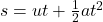
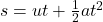
21. The equation
gives
A) displacement under constant acceleration B) final velocity C) acceleration only D) time only
22. For constant acceleration, the equation relating velocities and displacement is
23. Average velocity for constant acceleration is
24. If a body starts from rest with acceleration
, its velocity after 5 s is
A) 5 m/s B) 7 m/s C) 25 m/s D) 10 m/s
25. A car has initial velocity 10 m/s and acceleration 2 m/s². Its velocity after 4 s is
A) 18 m/s B) 14 m/s C) 12 m/s D) 20 m/s
26. A body starts from rest and accelerates at
for 4 s. Its displacement is
A) 12 m B) 24 m C) 18 m D) 48 m
A) 18 m B) 24 m C) 21 m D) 27 m
28. A body moving at 20 m/s comes to rest in 5 s. Its acceleration is
A) 4 m/s² B) -5 m/s² C) 5 m/s² D) -4 m/s²
29. When acceleration is opposite to velocity, the speed generally
A) decreases B) increases C) remains infinite D) becomes displacement
30. At the highest point of vertical upward motion, instantaneous velocity is
A) maximum B) zero C) equal to acceleration D) negative infinity
31. In free fall near Earth’s surface, neglecting air resistance, acceleration is approximately
A) zero B) C) D) variable with mass
32. For an object thrown vertically upward, taking upward as positive, acceleration is
33. The displacement after time
for an object with initial velocity
and constant acceleration
is
34. If
is displacement, velocity is obtained by
A) integrating B) differentiating C) squaring D) dividing by acceleration
35. If
is velocity, acceleration is obtained by
36. If
is acceleration, change in velocity is obtained by
A) differentiating acceleration B) squaring acceleration C) dividing acceleration by time D) integrating acceleration with respect to time
37. If
, then acceleration at time
is
38. If
, then velocity is
39. If
, then acceleration is
40. If velocity is
, displacement from
to
is
A) 10 m B) 12 m C) 16 m D) 14 m
41. The displacement-time graph of uniformly accelerated motion is generally
A) a parabola B) a straight line C) a circle D) a horizontal line
42. The velocity-time graph for constant acceleration is
A) a parabola B) a straight line C) a circle D) a hyperbola
43. The area under a velocity-time graph from
to
gives
A) acceleration B) average speed only C) change in displacement D) force
44. A negative slope on a velocity-time graph indicates
A) positive acceleration B) constant displacement C) zero acceleration D) negative acceleration
45. If the velocity-time graph crosses the time axis, the velocity
A) changes sign B) remains positive C) becomes infinite D) must remain zero
46. Relative velocity of A with respect to B is
47. If two cars move in the same direction with speeds 60 km/h and 40 km/h, the relative speed of the first with respect to the second is
A) 60 km/h B) 40 km/h C) 20 km/h D) 100 km/h
48. If two objects move toward each other at 30 m/s and 20 m/s, their relative speed is
A) 10 m/s B) 20 m/s C) 30 m/s D) 50 m/s
49. For a particle with position
, its velocity is
A) 5 m/s B) 0 C) 10 m/s D) 25 m/s
50. For
, velocity at
s is
A) 3 m/s B) 6 m/s C) 9 m/s D) 12 m/s
Show Result Try Again
Syllabus & SLO Alignment
This set covers the Class 12 Mathematics Kinematics of Motion in a Straight Line content represented in the uploaded chapter file, including distance, displacement, speed, velocity, acceleration, motion graphs, differentiation and integration with respect to time, uniformly accelerated motion, and relative motion.
Finished the MCQs? Share with your friends!
 B)
 C)
 D)

 gives
 C)
 D)

 B)
 C)
 D)

 , its velocity after 5 s is
 for 4 s. Its displacement is
 ,
 , and
 , then
 is
 upwardC)
 downwardD) variable with mass
 B)
 C) zeroD)

 for an object with initial velocity
 and constant acceleration
 is
 B)
 C)
 D)

 is displacement, velocity is obtained by
 is velocity, acceleration is obtained by
 onlyB)
 C)
 D)

 is acceleration, change in velocity is obtained by
 , then acceleration at time
 B)
 C)
 D)

 , then velocity is
 B)
 C)
 D)

 , then acceleration is
 B)
 C)
 D)

 , displacement from
 to
 is
 to
 gives
 B)
 C)
 alwaysD)

 , its velocity is
 , velocity at
 s is