Class 9 Physics Chapter 2 – Kinematics MCQs(FBISE)

Description: Practice Class 9 Physics Chapter 2 Kinematics MCQs according to the latest FBISE syllabus. These exam-oriented multiple-choice questions cover rest and motion, distance, displacement, speed, velocity, acceleration, graphs, and equations of motion.

1. Kinematics is the branch of physics that deals with:

A) Causes of motion
B) Description of motion without considering its causes
C) Heat and temperature
D) Electric current

2. A body is said to be in motion if it changes its position with respect to:

A) A reference point
B) Its mass
C) Its colour
D) Its temperature

3. The SI unit of displacement is:

A) Kilometer
B) Centimeter
C) Mile
D) Meter (m)

4. Distance is a:

A) Vector quantity
B) Derived force
C) Scalar quantity
D) Dimensionless quantity

5. Which of the following is a vector quantity?

A) Speed
B) Velocity
C) Distance
D) Time

6. Average speed is given by:

A) \frac{\text{Total Distance}}{\text{Total Time}}
B) \frac{\text{Displacement}}{\text{Time}^2}
C) \text{Distance} \times \text{Time}
D) \frac{\text{Velocity}}{\text{Time}}

7. The SI unit of velocity is:

A) km/h
B) cm/s
C) m/h
D) m/s

8. If an object covers equal distances in equal intervals of time, it is in:

A) Accelerated motion
B) Random motion
C) Uniform motion
D) Circular motion

9. Acceleration is defined as the rate of change of:

A) Distance
B) Velocity
C) Mass
D) Time

10. The formula for acceleration is:

A) a = \frac{v-u}{t}
B) a = vt
C) a = \frac{s}{t}
D) a = uv

11. The SI unit of acceleration is:

A) m/s
B) km/h²
C) N
D) \text{m/s}^2

12. The area under a velocity-time graph represents:

A) Speed
B) Displacement
C) Acceleration
D) Force

13. The slope of a velocity-time graph gives:

A) Acceleration
B) Distance
C) Speed
D) Momentum

14. Which equation of motion is correct?

A) s = ut
B) v = ut
C) v = u + at
D) a = uv

15. A body moving with constant velocity has:

A) Increasing acceleration
B) Variable acceleration
C) Infinite acceleration
D) Zero acceleration

16. In the equation v = u + at, the symbol u represents:

A) Initial velocity
B) Final velocity
C) Average velocity
D) Uniform velocity

17. If a car travels 120 m in 10 s, its average speed is:

A) 10\,\text{m/s}
B) 12\,\text{m/s}
C) 15\,\text{m/s}
D) 20\,\text{m/s}

18. Which of the following is a scalar quantity?

A) Displacement
B) Velocity
C) Speed
D) Acceleration

19. Displacement is the:

A) Shortest distance between initial and final positions with direction
B) Total path length traveled
C) Product of speed and time
D) Rate of change of speed

20. A person walks 5 m east and then 5 m west. The displacement is:

A) 10 m
B) 5 m
C) -5 m
D) 0 m

21. The slope of a distance-time graph represents:

A) Acceleration
B) Speed
C) Force
D) Momentum

22. If the velocity-time graph is a horizontal line, the object is moving with:

A) Constant velocity
B) Constant acceleration
C) Zero displacement
D) Increasing speed

23. Which equation is used to calculate displacement under uniform acceleration?

A) v=u-at
B) a=\frac{s}{t}
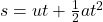
C) s=ut+\frac{1}{2}at^2
D) F=ma

24. In the equation v^2=u^2+2as, the symbol s denotes:

A) Speed
B) Second
C) Scalar
D) Displacement

25. A negative acceleration is commonly called:

A) Uniform acceleration
B) Deceleration
C) Instantaneous velocity
D) Average speed

26. If u=5\,\text{m/s}, a=2\,\text{m/s}^2, and t=4\,\text{s}, then v is:

A) 13\,\text{m/s}
B) 11\,\text{m/s}
C) 8\,\text{m/s}
D) 15\,\text{m/s}

27. Which quantity includes both magnitude and direction?

A) Distance
B) Speed
C) Velocity
D) Time

28. An object at rest has a speed of:

A) 1\,\text{m/s}
B) -1\,\text{m/s}
C) Depends on mass
D) 0\,\text{m/s}

29. Which graph can directly show acceleration from its slope?

A) Distance-time graph
B) Velocity-time graph
C) Mass-time graph
D) Area-time graph

30. The average velocity is equal to:

A) \frac{\text{Displacement}}{\text{Time}}
B) \frac{\text{Distance}}{\text{Time}^2}
C) Distance × Time
D) Speed × Time

31. A freely falling object near Earth’s surface experiences an acceleration of approximately:

A) 5\,\text{m/s}^2
B) 12\,\text{m/s}^2
C) 15\,\text{m/s}^2
D) 9.8\,\text{m/s}^2

32. If acceleration is zero, the velocity is:

A) Always zero
B) Constant
C) Always increasing
D) Always decreasing

33. The quantity \frac{v-u}{t} represents:

A) Speed
B) Distance
C) Acceleration
D) Momentum

34. A straight-line distance-time graph indicates:

A) Uniform speed
B) Non-uniform acceleration
C) Zero displacement
D) Circular motion

35. Which of the following is the second equation of motion?

A) v=u+at
B) s=ut+\frac{1}{2}at^2
C) v^2=u^2+2as
D) a=\frac{v}{t}

36. If a car travels around a circular track and returns to its starting point, its displacement is:

A) Equal to the circumference
B) Equal to the radius
C) Zero
D) Equal to the diameter

37. An object moving with constant speed in a straight line has:

A) Zero acceleration
B) Constant acceleration
C) Increasing velocity
D) Negative acceleration

38. Which of the following is measured in \text{m/s}?

A) Acceleration
B) Force
C) Displacement
D) Velocity

39. The graph of a body at rest on a distance-time graph is:

A) A straight sloping line
B) A horizontal line
C) A vertical line
D) A curved line

40. If u=0, a=5\,\text{m/s}^2, and t=6\,\text{s}, then v is:

A) 30\,\text{m/s}
B) 25\,\text{m/s}
C) 11\,\text{m/s}
D) 36\,\text{m/s}

41. Which equation can be used when time is not given?

A) v=u+at
B) s=ut+\frac{1}{2}at^2
C) v^2=u^2+2as
D) a=\frac{v-u}{t}

42. The change in velocity per unit time is called:

A) Speed
B) Displacement
C) Momentum
D) Acceleration

43. If the velocity-time graph has a negative slope, the object is:

A) Decelerating
B) Moving with constant velocity
C) At rest
D) Moving with increasing acceleration

44. Which quantity can never be negative?

A) Velocity
B) Distance
C) Displacement
D) Acceleration

45. A cyclist travels 90 m in 15 s. The average speed is:

A) 4\,\text{m/s}
B) 5\,\text{m/s}
C) 7\,\text{m/s}
D) 6\,\text{m/s}

46. In uniform motion, the distance covered in equal intervals of time is:

A) Always decreasing
B) Random
C) Equal
D) Zero

47. The SI unit of speed is:

A) \text{m/s}
B) \text{m/s}^2
C) km
D) N

48. If an object starts from rest, then its initial velocity u is:

A) 1\,\text{m/s}
B) 0\,\text{m/s}
C) 9.8\,\text{m/s}
D) Depends on mass

49. Which statement is true?

A) Distance is always equal to displacement.
B) Velocity is a scalar quantity.
C) Speed has both magnitude and direction.
D) Distance is always greater than or equal to the magnitude of displacement.

50. Which of the following is the third equation of motion?

A) a=\frac{v-u}{t}
B) v=u+at
C) v^2=u^2+2as
D) s=\frac{v}{t}

Leave a Comment

Your email address will not be published. Required fields are marked *

Scroll to Top