Practice 50 exam-oriented MCQs covering matrices, matrix operations, determinants, inverse matrices and related concepts for FBISE HSSC-I Mathematics.
1. A matrix is a rectangular arrangement of numbers or elements in:
2. The order of a matrix having 3 rows and 4 columns is:
3. A matrix having the same number of rows and columns is called a:
4. A matrix with only one row is called a:
5. A matrix with only one column is called a:
6. A matrix of order 2 × 3 contains:
7. Two matrices are equal if they have the same order and their corresponding elements are:
8. A matrix in which every element is zero is called a:
9. The identity matrix of order 2 is:
10. In a square matrix, the entries from the upper-left corner to the lower-right corner form the:
11. A diagonal matrix has all its elements outside the principal diagonal equal to:
12. A scalar matrix is a diagonal matrix in which all diagonal elements are:
13. The transpose of a matrix is obtained by interchanging its:
14. If A is a 2 × 3 matrix, then the order of Aᵀ is:
15. A square matrix A is symmetric if:
16. A square matrix A is skew-symmetric if:
17. The diagonal elements of a skew-symmetric matrix are always:
18. Two matrices can be added only when they have:
19. If A and B are conformable for addition, then A + B is obtained by:
20. Matrix addition is:
21. The additive identity for matrices is the:
22. The additive inverse of a matrix A is:
23. If A is a matrix, then A + (−A) equals:
24. Multiplication of a matrix by a scalar means multiplying:
25. If A is of order 2 × 3 and B is of order 3 × 4, then AB has order:
26. For the product AB to be defined, the number of columns of A must equal the number of:
27. In general, matrix multiplication is:
28. If AB is defined, the element in row i and column j of AB is obtained by:
29. Matrix multiplication is associative, so for conformable matrices:
30. The distributive law for matrices includes:
31. The determinant of a 2 × 2 matrix  is:
is:
32. The determinant of  is:
is:
33. A determinant is defined for:
34. If the two rows of a determinant are identical, its value is:
35. If two rows of a determinant are interchanged, the determinant:
36. If all elements of one row of a determinant are multiplied by k, the determinant is multiplied by:
37. The determinant of an identity matrix of any order is:
38. The determinant of a triangular matrix is equal to the:
39. A square matrix A is singular if:
40. A square matrix A is non-singular if:
41. If A is a 2 × 2 matrix, then an inverse A⁻¹ exists when:
42. For a non-singular square matrix A, the product AA⁻¹ is:
43. The inverse of a 2 × 2 matrix  , when
 , is:
, when , is:
A) 
B)
C)
D)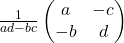
B)
C)
D)
44. The determinant of  is:
is:
45. If  , then
 is:
, then is:
A)
B)
C)
D)
B)
C)
D)
46. If  , then A is:
47. If A and B are matrices of the same order, then  equals:
A) 
B)
C)
D)
B)
C)
D)
48. If  , A is a:
49. The determinant of a matrix with a row of all zeros is:
50. If  for a non-singular square matrix A, then
 is:
for a non-singular square matrix A, then is:
A) 3
B) −3
C)
D) 0
B) −3
C)
D) 0
Explore More Class 11 Mathematics MCQs
Chapter 1 – Complex Numbers
Chapter 2 – Matrices and Determinants
Chapter 3 – Vectors
Chapter 4 – Sequences and Series
Chapter 5 – Polynomials
Chapter 6 – Permutation and Combination
Chapter 7 – Mathematical Induction and Binomial Theorem
Chapter 8 – Fundamentals of Trigonometry
Chapter 9 – Trigonometric Functions
Chapter 2 – Matrices and Determinants
Chapter 3 – Vectors
Chapter 4 – Sequences and Series
Chapter 5 – Polynomials
Chapter 6 – Permutation and Combination
Chapter 7 – Mathematical Induction and Binomial Theorem
Chapter 8 – Fundamentals of Trigonometry
Chapter 9 – Trigonometric Functions
Class 11 Mathematics Main Hub
Class 11 Mathematics Chapter-wise MCQs – FBISE
Class 11 All Subjects Main Hub
Syllabus & SLO Alignment
These MCQs are designed around the chapter’s core matrices and determinants concepts: matrix formation and order, equality and types of matrices, transpose, symmetric and skew-symmetric matrices, addition and scalar multiplication, matrix multiplication and its laws, determinants, determinant properties, singular and non-singular matrices, and inverse matrices. The questions emphasize knowledge, understanding and application-oriented practice suitable for FBISE-style preparation.